
Things that have changed my life living with lipedema (Part 1)
More tips are coming. And I want to hear yours, too.


Lipedema is inflammation. That is really what it comes down to. So everything I do, I am thinking — will this help bring it down?
Here are four things that have actually made a difference for me. This is just part 1. There is more to come.
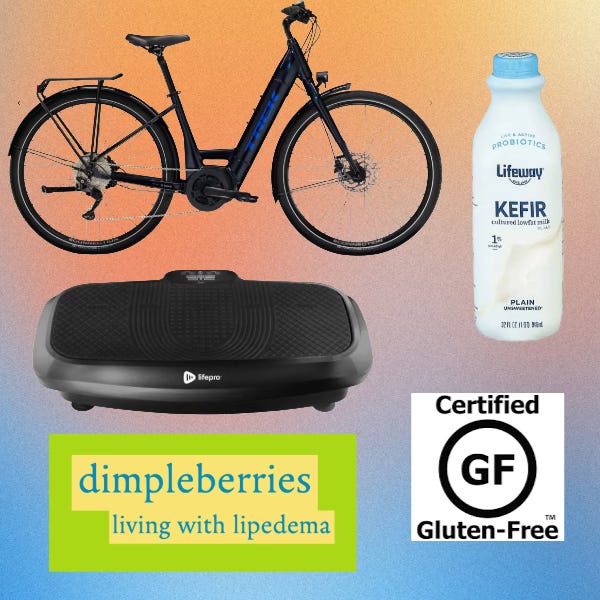
1. Drinking kefir every day
Three years ago I started drinking kefir every day and honestly, it has been a game changer — for my inflammation and my stomach. I learned about in a class, and I never looked back. And the science backs it up.
Research shows kefir works by shifting your immune response, lowering the inflammatory markers in your body while raising the anti-inflammatory ones.
A University of Nottingham study found that people who combined kefir with prebiotic fiber saw the biggest drop in whole-body inflammation compared to people taking omega-3 or fiber alone. My gut feels better. My inflammation feels more manageable. I drink it on a daily basis. This one is not going anywhere.
2. A vibration plate
I have had a vibration plate for four years and on the nights when my legs are extra painful, this is what I reach for. The research is still catching up on this one.
In an interview with Consumer Reports, lipedema expert and endocrinologist Karen Herbst says whole-body vibration may help because it improves blood flow through tissue and supports lymphatic flow — and that just standing on one and focusing the vibration on different body parts can help.
A randomized controlled trial of 30 women with lipedema found that adding vibrotherapy to manual lymphatic drainage produced dramatically better results than lymphatic drainage alone, with significantly greater reductions in limb size and notable improvements in quality of life.
Is it a cure? Absolutely not. Does it help me get through hard nights? Every single time. Your lymphatic system depends on movement to keep fluid flowing. And when moving hurts, this is a comfortable way to keep things going.
3. Going gluten-free
When my doctor diagnosed me with lipedema, one of the first things she told me was to change my diet. Going gluten-free was part of that, and two years in, it is one of the best decisions I have made. My energy is back and I have less pain.
A 2024 peer-reviewed study found that gluten can trigger an inflammatory cascade in the body — compromising gut permeability, allowing harmful molecules into the bloodstream and setting off an immune response that can reach far beyond the digestive system.
Research also found a possible connection between gluten intake and the inflammation specifically seen in lipedema.
Is it inconvenient? It can be. Do I miss freshly baked bread from a bakery? Yes. But the way my body feels without it makes it completely worth it. And you learn to love gluten-free alternatives.
4. Biking
This one is a recent revelation and it has genuinely surprised me. Lipedema has impacted my mobility. I can walk — it is just hard. And I kept telling myself I would walk more, and then not doing it, and feeling bad about it. Then one day I went out biking with my husband and our dog and something just clicked. I wanted to do it again the next day. I do not have that feeling with walking anymore, and I realized it is because biking does not remind me how hard walking is with lipedema. It just feels like freedom.
A systematic review of exercise training in women with lipedema found that exercise improved pain, quality of life, limb size and functional performance — with even greater results when combined with compression therapy.
The Lipedema Foundation specifically lists cycling among its recommended exercises, noting that the goal is to keep the lymphatic system moving, take care of joints and build strength.
The best exercise is the one you will actually do. For me, right now, that is biking.
Lipedema does not have a cure yet. But it does have a community of women figuring it out together. These four things have helped me feel more like myself again, and that is everything. More to come!